

Happy New Year! Ready for 2026? Me neither — but we'll chart the chaos together. Let's go!
💙 Amanda
A lot happened in 2025. Global uncertainty. Fighting in Ukraine and Gaza. Tariffs. Labubu. Wildfires in LA. 6-7.
Here's a year-end review that won't include any of those things: The most-read, English-language Wikipedia page for every day of 2025.
This data doesn't reveal the most significant events of the year, the people who had the greatest impact, or even what we found most important. Looking at the most-read Wikipedia pages is like holding a mirror up to our collective curiosity.
In 2025, English speakers wondered about MrBeast, Google and the Pope. But the majority of our wiki searches were inspired by popular entertainment and notable deaths.
Wikipedia pages about entertainment or recent deaths dominated our interest
Just over half of all days had a most-read page related to one of these two categories
To me, this isn't surprising. I used to work at an online publication called Quartz (RIP 🪦), and for a few years we produced a similar end-of-year review. When I did this analysis for 2020 and 2021, the results were similar. It turns out, we're pretty consistently interested in entertainment and death.
And just like you won't find any top 2025 pages about Ukraine, tariffs or MAGA, none of the most popular Wikipedia pages in 2021 were related to the ongoing coronavirus pandemic.
Some top reads are obvious, some are surprises, and a handful are head-scratchers. I labelled pages with similar reasons for popularity the same way. For instance, deaths are denoted by a 😵, entertainment topics are indicated with a 📺, sports-related are 🏆, and pages that don't fit elsewhere are indicated with a 🪿.
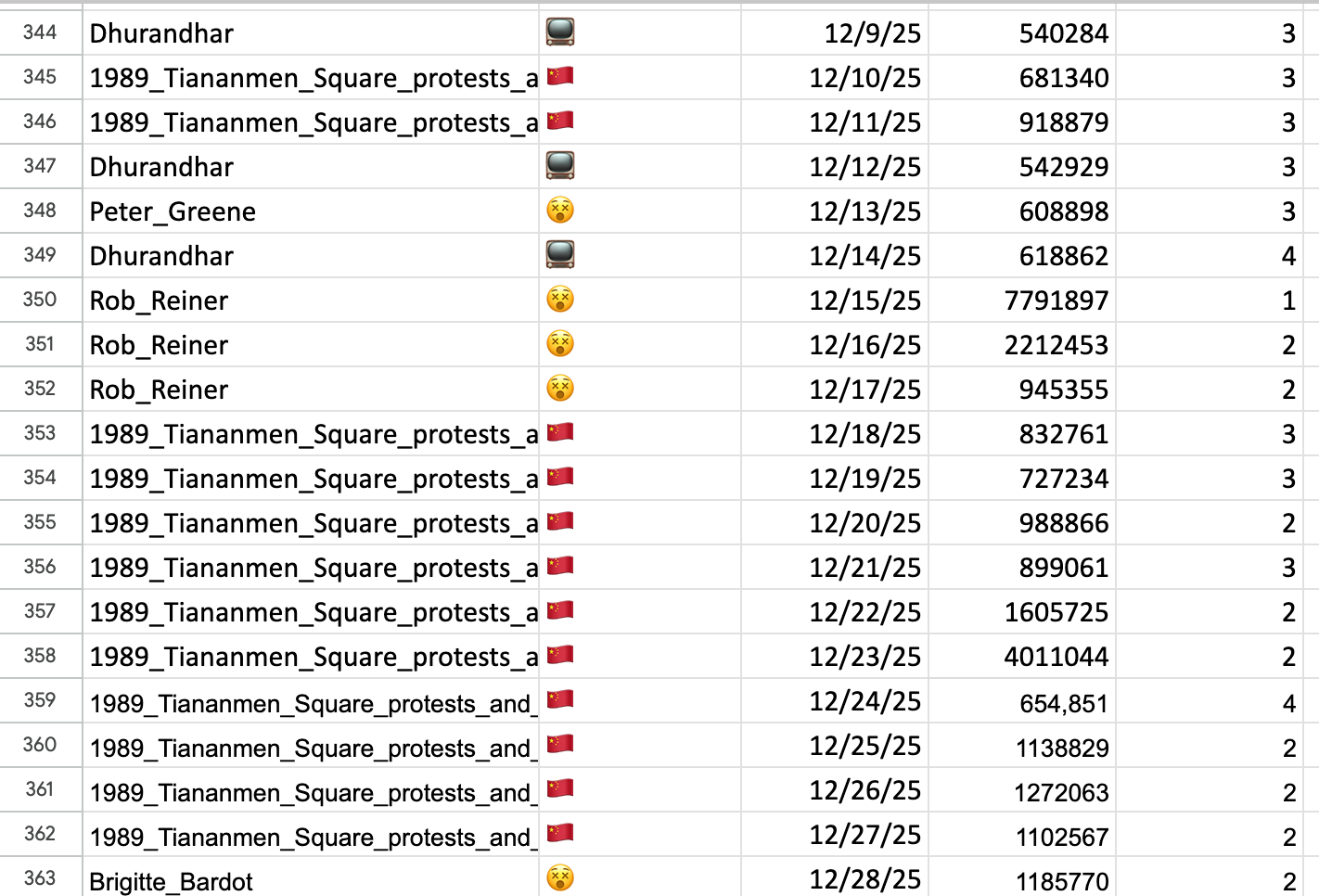
See that last day of March? On that date the Tiananmen Square protests and massacre article was the most-read English-language Wikipedia page. This isn't particularly notable yet, but watch as this pops up again — and again.
On the last day of June, the Hess Triangle was the most-read page. This is a quirky bit of New York architecture. The Hess Triangle is a 500-square-inch private plot in the middle of a public sidewalk that was part of an early 20th century land dispute. Today it reads: "Property of the Hess Estate, which has never been dedicated for public purposes." It's historical pettiness at its best. But why so popular on that day? Who knows.
[Update! A reader pointed out that this traffic was probably driven by a Reddit post about the triangle.]
The page for Charlie Kirk, the assassinated conservative activist, was the most-read of the entire year. This is according to Wikipedia's own year-end analysis, completed in November. The page for the American serial killer Ed Gein was third; Donald Trump was fourth.
So, there was a lot of interest in the Tiananmen Square protests in December. In fact, this Wikipedia page was the most-read on 25 days. I failed to find any reason for this, however, and I'm pretty confident it's due to bot activity. Bots drive noticeable traffic to other Wikipedia sites — the page about the .xxx domain, for one — but since I can't be sure, I kept Tiananmen Square in the data.
Bots aside, looking at 2025's top Wikipedia pages reveals a comforting pattern. While the world churns through crisis after crisis, our curiosities remain remarkably stable: People watch the same things, and talk about the same sports. People die, and we want to know their stories. We share an interest in Marvel movies, Papal elections, and serial killers. I don't know that it's particularly profound. But it does seem particularly human.
The Wikipedia data excludes the main page and the search page, which often occupy the top spot. I also removed the page for ".xxx", which is a known false positive. Finally, there were a number of days during which "Google" was the most read. According to Wikipedia's own year-end analysis, these are likely mistakes. So, I took them out, too.
And a thank you
A wonderful human being — and paid subscriber! — deserves a great big thank you for helping with this piece. My editor at Quartz, David Yanofsky, still had the code we used to scrape the Wikipedia data. He kindly shared it with me. A much needed time saver!
NEED MORE?
If you want to look more deeply into Wikipedia's daily rankings, this site lets you explore one day at a time. Better yet — become a paid member of Not-Ship and get access to a spreadsheet with all the data. That's not it; you'll also get access to the data behind every single Not-Ship post.
FROM ELSEWHERE
Here's what I found interesting, important or delightful this week:
Some data centres are too hot. Countries with hot climates are investing millions of dollars in building data centres. Rest of World maps these locations, and details the growing problem.
And some data centres are secretly owned by Meta. This deep dive from Sherwood reveals billions in investment, covert code names and enough tax breaks to pay every state copy in Louisiana for seven years. The Richard Scarry-style illustrations are the cherry on top.

Our days are tied to our years. Flowing Data explores who we spend our time with by looking at the American Time Use Survey. The patterns are in our age.
MORE NOT-SHIP
 Amanda Shendruk
 Amanda Shendruk
 Amanda Shendruk
Member discussion