

Happy Wednesday! If you've been enjoying these emails, can you do me a favour? Share this with like-minded friends or colleagues. Your recommendation would mean a lot to me.
💙 Amanda
If you read last week's newsletter — my 250-year performance review of the United States — you might have noticed a chart with a shockingly steep drop. The kind of sheer plummet that says "something is really wrong here".
Here's what I'm talking about.
Freedoms in the US were on the rise — until recently
Freedom of Expression Index, Academic Freedom Index and Civil Liberties Index, 1789 to 2025.
See it? In the US, academic freedom has dropped to levels never seen before. The chart looks like an error. But it's not. And because many Not-Ship readers are academics, I decided to take a small detour this week to look more deeply into that data.
I'll be honest, I assumed this was another American outlier. But I was so wrong; this drop is not at all unique to life under Trump 2.0. Academic freedoms around the world are in decline.
We know this because of the Academic Freedom Index. It is part of the V-Dem project, which does some of the most extensive research in the world on democracies. The index itself is built from the assessments of over 2,000 country experts.
And that work reveals something that genuinely surprised me: Nearly seven in ten countries have seen academic freedoms worsen since 2015.
In the last decade, academic freedoms deteriorated in 67% of countries
Change in Academic Freedom Index from 2015 to 2025.
Nicaragua's index saw a 95% drop, the greatest percent decline of any country. Under Daniel Ortega, the government has targeted universities— revoking their status, and closing some entirely — for their role in antigovernment protests.
At the same time, America's index fell by 57%. The extreme drop is tied closely to the second Trump administration, which has aggressively cut research funding, taken aim at DEI initiatives, and revoked student visas. Today, the US shares levels of academic freedom with Bhutan, Thailand, and the West Bank.
The Academic Freedom Index measures five things: Freedom to research and teach, freedom of academic exchange and dissemination, institutional autonomy, campus integrity (if there's a climate of insecurity or intimidation), and freedom of academic and cultural expression.
In the US, all five of these measures have declined, but institutional autonomy and freedom to research and teach show the greatest drops.
There are a few good news stories here. Did you notice Iraq, Bangladesh and Fiji? They're among the small handful of countries that actually saw improvement over the last decade. In many of those states, the progress was tied to major regime changes.
In 2015, many areas in Iraq were under ISIS control. After their defeat, the country began rebuilding its university system. Similarly, Fiji's growth followed the end of Bainimarama's 16-year rule in 2022. And in Syria, universities are finding their footing after the collapse of the Assad regime.
And in Europe, the downward trend continues. In 2015, European nations had some of the strongest academic freedoms in the world. They're still strong, but aside from the tiny country of Montenegro, they're all sliding backwards.
The UK is particularly embarrassing. Today, the country that is home to Oxford and Cambridge has the lowest academic freedom index in Western Europe. Why? A chilling effect on those that research politically charged topics, heavy-handed responses to student protestors, and university models that prioritize growth above all else. It now ranks 82nd of 179 nations, far behind many of its former colonies, including Canada, Australia, New Zealand, South Africa and Kenya.
All this reminds me of a piece I wrote a few months ago about the global decline in democracy. That was V-Dem data, too. What looked like an American story — a rapid decline in democratic standards — turned out to be a global one, with the US as one of its most dramatic examples.
The trends are connected. In 2024, the UK lost its status as a liberal democracy; the US followed in 2025. According to V-Dem's own research, 64% of governments sliding toward autocracy specifically target academic freedom as part of that process.
I promise V-Dem is not a sponsor of this newsletter. But their data are so good, I'd happily take their money. Call me, V-Dem. ☎️
To my academic friends: You probably didn't need a chart to tell you things have shifted. But now you've got the data to confirm it. Sorry.
HOW THIS WORKS
Not-Ship is free for everyone. And that's absolutely by design. We could all use more data — informing our conversations, our decisions, and the way we see the world — and none of us need more ads or paywalls in the way.
But in order for it to stay free, some people simply need to chip in. It's $9/month or $90/year. The model only holds if the people who can pay, do. I hope that's you.
FROM ELSEWHERE
Here's what I found interesting, important or delightful this week:
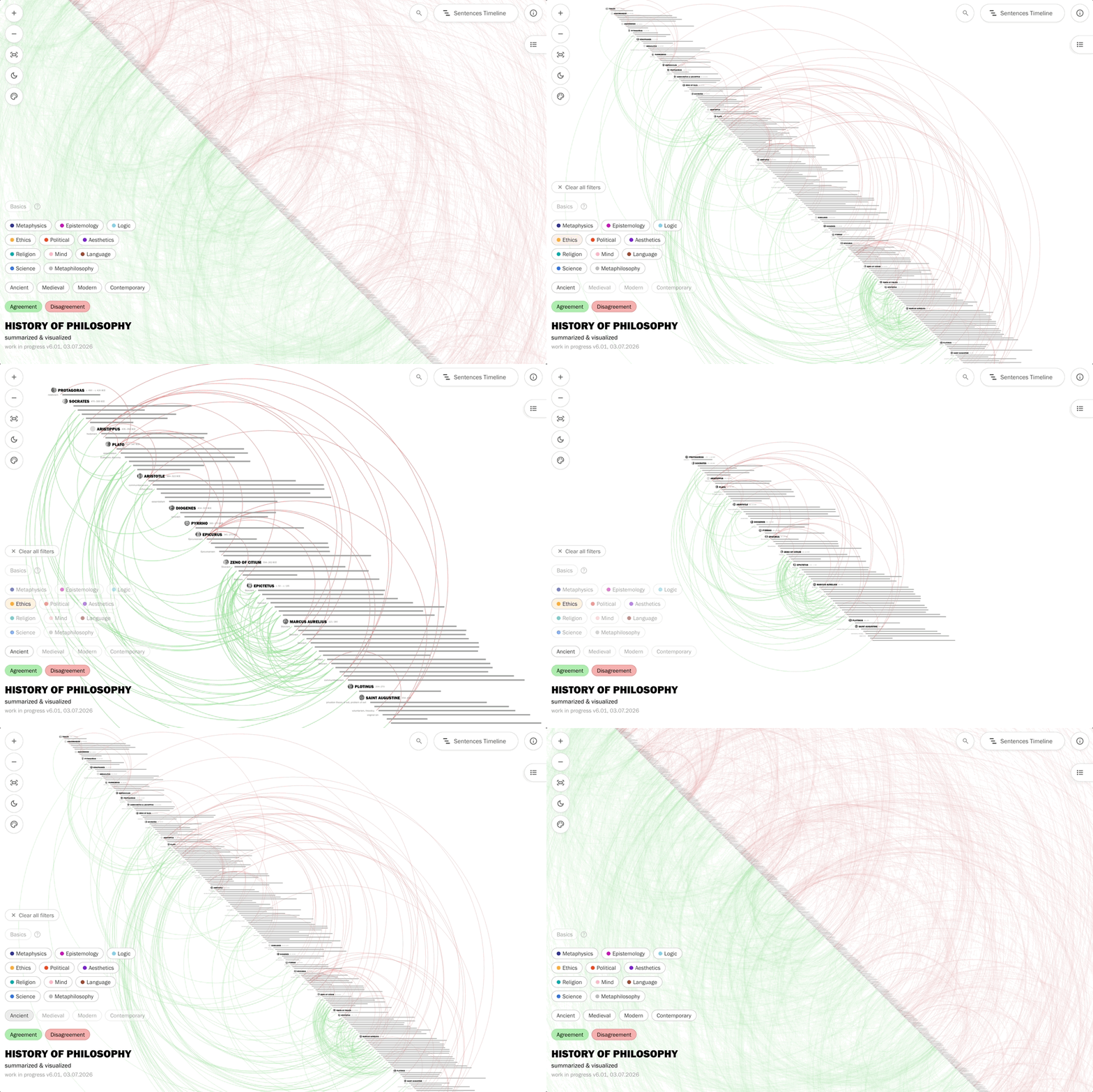
Philosophy, visualized. At first glance, this interactive graphic of the history of philosophy is overwhelming. But very much like philosophy itself, it gets better the deeper you go.
Listen up. I'm listening to CBC's Uncover again — what a great podcast! It's thoughtful and thorough true crime reporting, with a different journalist hosting each of its 37 seasons (not a dud among them). Start with The Village or Sea of Lies.
MORE NOT-SHIP
 Amanda Shendruk
 Amanda Shendruk
 Amanda Shendruk
Member discussion