

Celebrations for our North American readers! Yesterday was Canada Day, and Saturday is Independence Day. Here's something for you to talk about over the BBQ this weekend. (Living in Europe has many pros, but I do miss a good BBQ). Enjoy!
💙 Amanda
This weekend, the United States marks its 250th anniversary. I think it's due for an assessment. Has the country been satisfactory in meeting its goals?
America's founding document set clear key performance indicators (KPIs) from day one. The Declaration of Independence named three unalienable rights — "life, liberty and the pursuit of happiness" — and made it the government's job to protect them.
Time for a performance review.
KPI: Life
In 1880, the oldest data I can find, life expectancy in the United States was 39.4 years. Today, that number has nearly doubled. For over 100 years, the US has had a similar life expectancy as the UK, both of which have been tracking steadily upwards.
On average, Americans live 79.3 years
Life expectancy at birth, 1900 to 2023.
Compared to 237 other regions in the world, the US currently ranks 62 for greatest life expectancy (sitting between Albania and Estonia). It's no Monaco, but it's in the top 30% of countries.
However, averaging over all deaths can hide some nuance. In the US, that nuance is the significant difference in expected life span based on race and ethnicity.
Indigenous Americans have the worst life expectancy in the US
Life expectancy at birth, 2023.
KPI: Liberty
Unlike life, liberty doesn't come with a universally agreed benchmark. So we'll look at a couple different ones.
First, the ability to freely go about your life. In the US, 5 in 1000 people don't have this. Because they're in jail.
The US has one of the highest prison populations in the world
While this number is shockingly large, there's a small upside. The rate peaked at 750 in 2008 and has been falling since (looking at data that go back to 2000).
But the "liberty" in the Declaration of Independence was probably written more as a statement on natural rights. The freedom to act and think for oneself, without too much interference from the state.
There's a measure for that, too. V-Dem does some of the world's most-extensive research on democracies. And they've assessed various freedoms going back hundreds of years.
Freedoms in the US were on the rise — until recently
Freedom of Expression Index, Academic Freedom Index and Civil Liberties Index, 1789 to 2025.
It appears the US really was "home of the free" for a while. But in the last five to ten years, freedom of expression, academic freedom and the Civil Liberties Index, which measures the extent to which governments respect and protect fundamental human rights and freedoms, have dropped significantly. Today, freedom of expression and civil liberties are at levels last seen in the 1950s and 60s. And academic freedom? That vertical plummet needs to be the focus of an entire piece. (Let's circle back on this).
KPI: The pursuit of happiness
How can we assess if today's Americans are happier than those living in the 18th century? I mean, indoor plumbing, stretchy jeans and Toy Story (the first one) must mean we're happier now. But there's no way to know.
We can really only look, roughly, at how happy people are today. The World Happiness Report has been trying to understand this sentiment for almost 15 years.
America's ranking in the Happiness Index has dropped since 2012
US ranking amongst 147 countries.
Such a drop in rankings doesn't necessarily mean a corresponding change in happiness. Maybe other countries just got really happy? America's fall in the rankings, though, is accompanied by a slight drop in the metric that measures how satisfied people are with their lives. Either way, the US is still in the top 20% of happiest countries.
Self-assessment and peer feedback
If you ask Americans themselves how the country is doing, most aren't pleased. And it's not a new trend.
Americans have been dissatisfied since the turn of the century
Percent of US adults who say they are satisfied or dissatisfied with the way things are going in the US today, 1991 to 2026.
Outside reviewers tend to have a negative view of America, too. Pew polled the people of 35 countries about their opinion of the US: In just 12 of them, more people held a favourable view than an unfavourable one.
Israel, Hungary and Ghana think the US is top notch. Most others disagree.
Percent of people who have a favourable or unfavourable opinion of the US, 2026.
Final assessment
From the 250-year view, the American project is going well. However, more recent performance suggests significant room for improvement.
Life: Meets expectations | Steadily improving for centuries, though a 62nd-place global ranking is a modest showing for a country that calls itself the greatest on earth. Flagging the racial and ethnic disparity as a key improvement area for the next review cycle.
Liberty: Needs improvement | Some marks for strong gains in the second half of the 20th century, but a sharp downward trend in the last five to ten years can't be ignored. Prioritize reversing the recent slide in freedoms and civil liberties before it hardens into a permanent trend.
Pursuit of happiness: Needs improvement | Still in the top 20% globally, but trending the wrong direction. Consider changing KPI to ensure "happiness" and not simply the "pursuit of happiness".
This assessment does not account for variables that don't show up directly in the KPIs but shape them anyways, such as healthcare access, housing affordability, economic inequality and a legacy of race- and sex-based exclusion that goes right back to that founding document. Factor those in, and even the "meets expectations" rating may not hold up under further review.
Two hundred fifty years in, the United States looks like a once-promising high achiever failing to meet the demands of the role. It may be time for a performance improvement plan.
YOUR TURN
Was this review too harsh? Not harsh enough? Send me your own 250-year assessment of the US! I'll share some next week.
ENJOYING NOT-SHIP?
Think of a paid subscription as your performance review for Not-Ship. Paying for this work shows me that you value it. And it gives me more time to focus on doing it even better — helping you understand data and why it matters to you. A paid membership is $9/month or $90/year.
Not ready to subscribe, or want to give a little extra? Consider a one-time bonus instead. No ongoing commitment required.
FROM ELSEWHERE
Here's what I found interesting, important or delightful this week:
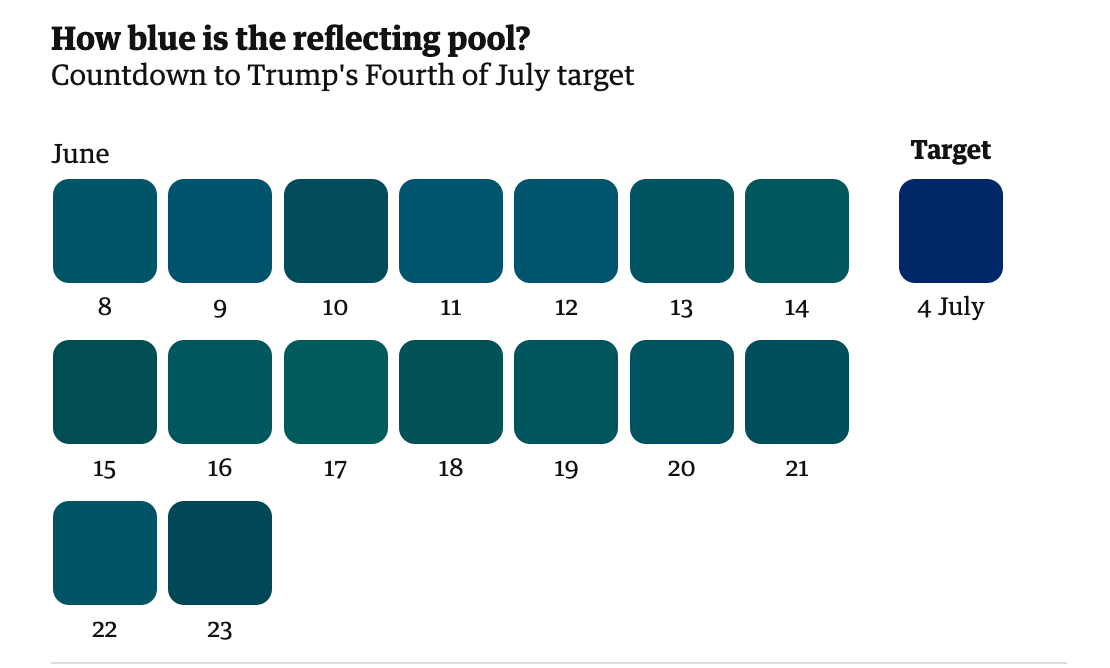
American flag green. This is my kind of journalism: From June 8 to 23, the Guardian tracked the colour of the Lincoln Memorial reflecting pool (graphic below). I wish they hadn't stopped. But I guess the point was made.
Historical climate monitor. Reuters recently launched a dashboard for comparing historical temperatures to today. It updates daily and is worth bookmarking, particularly if temperatures continue to soar.
MORE NOT-SHIP
 Amanda Shendruk
 Amanda Shendruk
 Amanda Shendruk
Member discussion