

I've been fighting a multi-week flu — and I'm not winning. Consequently, I just didn't have the strength to put together one of my in-depth data dives for you this week. But I have not left you without some numbers! (Want to support Not-Ship? I'll take it in the form of chicken noodle soup, or paid subscriptions.)
💙 Amanda
A few weeks ago, I ran the first ever Not-Ship survey. I was delighted with the number of responses! So many of you took the time to fill it out, and I really appreciate it.
Eighteen percent of Not-Ship's free subscribers, and 50% of paying subscribers completed the survey.
Here's what you had to say.
The value of Not-Ship
Form designers weigh in: I started off poorly. I think many people missed this slider.
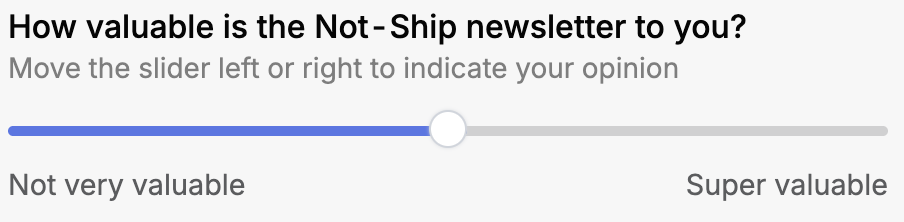
Nearly half of all responses (45%) were simply "50" — straight down the middle. Since survey takers tend to skew toward the passionate, not the indifferent, I think I'll chalk this up to a confusing rating widget and toss that data.
The reasons you read
I put a lot of work into making Not-Ship's visualizations clear and useful. Looks like you value them, too: They are the newsletter's biggest draw.
Which of the following are reasons that you subscribe to Not-Ship?
Categories selected by 50% or more of respondents.
Two other things stood out. A lot of you said you subscribe because you want to support independent journalism (becoming a paid subscriber is a great way to do that!). And nearly two thirds said you're behind the Not-Ship mission: We could all use more data. That was great to see.
The topics you love
This one surprised me: You want more content about data itself — how it's collected, used and misused. Count me in. I was also happy to see climate change and sustainability high on the list. It's something I want to spend more time on, too.
What topics do you want to see covered more often?
Includes all options.
For many of the topics I already cover, you wanted to see more. But in this data, the clearest signal was what ranked the lowest: US politics. Noted. You're not coming to Not-Ship for more of what's already out there.
The reasons you might pay
When I asked what might turn you into a paying subscriber, the overwhelming answer was "I just can't afford it right now".
What would motivate you to financially support Not-Ship?
Categories selected by 10% or more of respondents.
You know, I get it. Budgets are tight, and as one eloquent respondent put it: "There are just too many things to subscribe to — it's like being eaten alive by mosquitoes." But if Not-Ship makes the cut, I'm genuinely grateful.
Making Not-Ship better
The final question on the survey was open-ended: Is there anything I could do to make Not-Ship better for you?
Twenty-seven percent of you put something in this box, and there were a few recurring themes. A handful wanted to see more of the process, like how a dataset becomes a story, and how I turn complex topics into compelling visuals. And some asked for interactive data, so you can explore it yourselves.
Mostly, these responses were wonderfully positive. It was nice to hear that Not-Ship is working for you, that you're excited about the 'more data' mission and that you look forward to seeing it in your inbox each week.
Now what, Not-Ship?
The clearest message from the survey: Don't change too much. So I won't. A bit more climate, a bit less US politics, but mostly we'll stay the course. I was glad to see requests for interactive data, behind-the-scenes content and extra material for members. These are all things I want to do — just not yet. Not-Ship is a one-person operation and that one person is doing the best with the time she has.
A bigger group of paying subscribers would free up more of it.
Asked why you subscribe to this newsletter, a lot of you checked "I want to support independent journalism". I love that. And a paid subscription is exactly how you can do that.
The mission many of you believe in — that we could all use more data — is why I don't have paywalls. But I also don't have a parent company, or ad revenue or a Bezos.
Being independent means I don't have to push someone's agenda or produce work I don't fully believe in (buy me a beer and I'll tell you why I left the Washington Post). The tough part is that I'm in the fiscal wilderness. It's just us out here.
But "just us" can be enough — if enough of you decide it's worth it. Independent journalism survives when the people who believe in it pitch in.
READERS RESPOND
Last week I wrote about a new report that shows democracy on the decline. For the first time in over half a century, the US lost its status as a liberal democracy, and for the average global citizen, democracy has dropped to levels last seen in 1978.
I got some great responses; I'll share two.
First, a question:
"Obviously, the V-Dem report is chiming with what we feel but I would be interested in a follow-up note about the quality of the data used in this report," Alison Davidson wrote to me. "How are the scores calculated and how much can we trust them?"
The V-Dem report is one of the leading approaches to measuring democracy. It's a genuinely astounding endeavour: It surveys over 600 different attributes of democracy through a process that involves more than 4,200 scholars and country experts.
The organization measures democracy across five core principles — electoral, liberal, participatory, deliberative, and egalitarian — breaking each down into components like free and fair elections, civil liberties, judicial independence, media freedom, and gender equality. These, too, are broken down into specific indicators. The dataset behind the rankings has about 31 million data points.
As far as democracy measurements go, it's one of the most credible — used by places like the World Bank, the European Commission and loads of academic institutions. Our World in Data has a nice write-up explaining the V-Dem process in more detail.
Second, a connection:
Last week's piece included a chart showing the waves of democracy and autocracy throughout the last century. Here it is again:
Historically, waves of democratization are followed by waves of autocratization
The number of countries moving towards autocracy or democracy over the last century.
Attila Bátorfy, who runs the newsletter Cabinet of Infographic Curiosities, found a connection in his archive.
"There was a long-forgotten Hungarian author, Henrik Péchy, who wrote a book in 1938 about the waves of history. The book's title: The theory of historical waves and calculating the historical future," Attila shared on LinkedIn. "He also created a diagram to visualize his theory. He didn't think in terms of 'democracies' and 'autocracies' but rather in terms of 'revolutions' and 'absolutistic tendencies,' yet the patterns align with your graph."
Here's just a part of that diagram:
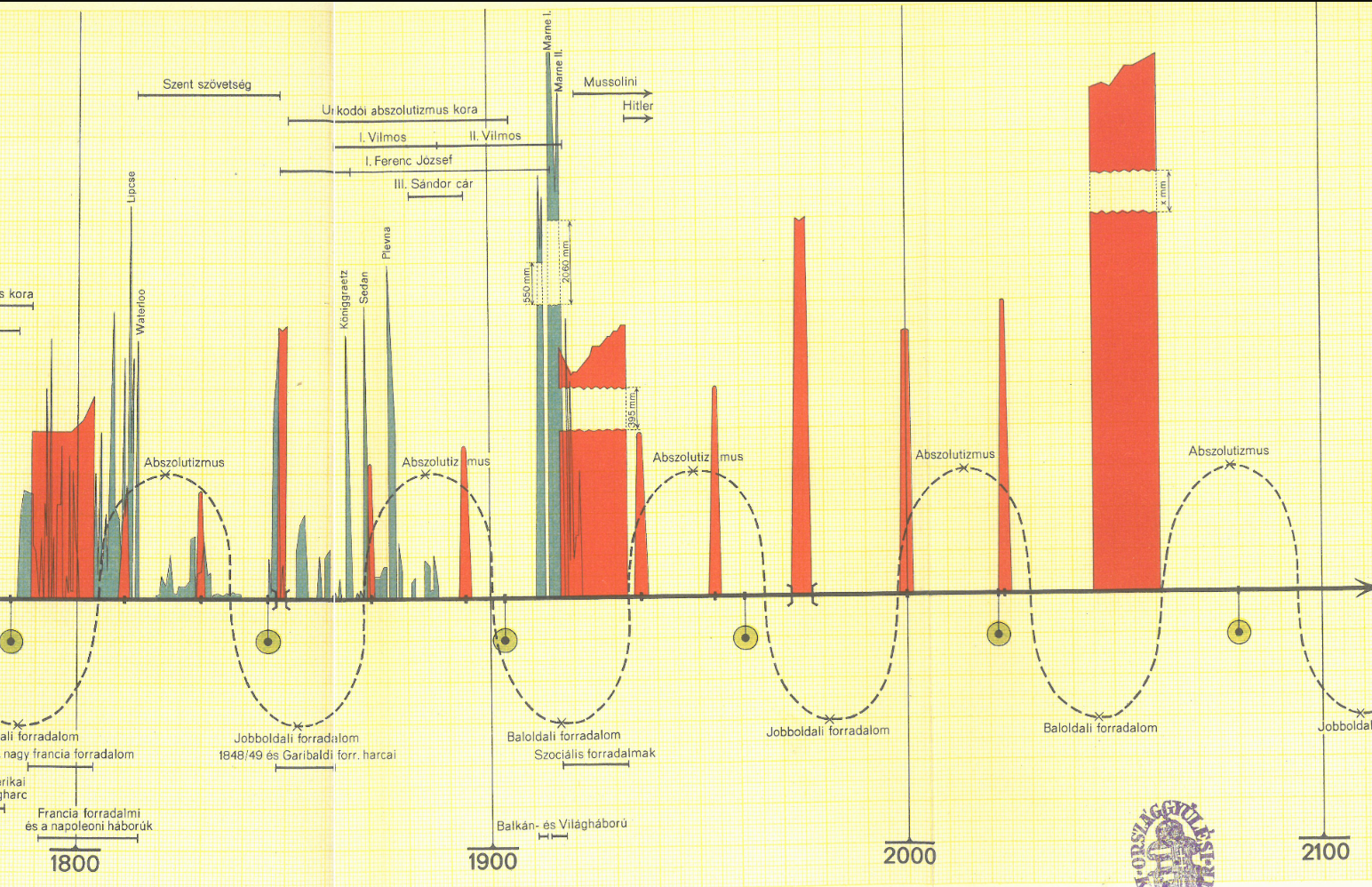
If Claude translated the Hungarian properly, the green circles are times of peace, blue spikes indicate wars and red shapes are revolutions. The dotted lines are the "rhythmic waves of history."
You can view the full diagram on the Cabinet of Infographic Curiosities website.
FROM ELSEWHERE
Here's what I found interesting, important or delightful this week:
Asteriod about to hit? This woman will let us know. Aarti Holla-Maini of the UN’s Office for Outer Space Affairs (you know, UNOOSA), has the peculiar job of sounding the alarm over a threat from space.
A review of 238 arrests. A powerful piece from Reuters about those awaiting justice in the aftermath of Hong Kong's national security crackdown.

MORE NOT-SHIP
 Amanda Shendruk
 Amanda Shendruk
 Amanda Shendruk
Member discussion