

Good morning to everyone who just doesn't want to go to work today! I took a much-needed long weekend, but my focus still seems to be on vacation. We can do it — half way to the weekend!
💙 Amanda
In Europe today: Schools are closed, records have been set, and deaths are adding up. We'd better talk about heatwaves.
And because we're a bunch of nerds, I'm going to jump right in with a methodological dilemma: There's no universal definition of a heatwave. A temperature that shuts down Oslo may be considered an ordinary summer's day in Delhi.
Some countries have their own thresholds. In Scotland, we are in an official heatwave if the temperature exceeds 25ºC (77ºF) for three days in a row. In London, that jumps to 28ºC. In places that can handle their heat? Singapore's threshold is 35ºC (95ºF), and in Malaysia, a heatwave isn't declared until three consecutive days over 37ºC.
Researchers, on the other hand, tend to define a heatwave relative to what's historically normal for a given place. They look for extremes that exceed some percentile of the local historical record, such as temperatures hotter than 95% of all pre-climate crisis days. And for it to be a heatwave, those extremes need to last. For how long? That's also in question: the IPCC defines a heatwave as lasting anywhere from two days to months, while the World Meteorological Organization requires five consecutive days of temperatures at least 5°C above the historical average.
Despite these variations in measurement, the data are consistently clear: Extremely hot days are on the rise.
Heatwaves are becoming more frequent
The number of heatwave days each year above or below the 1961–1990 average.
These data show when the temperature exceeds the 90th percentile for the 1961-1990 period, and that line is very clearly going up. But the trend, of course, gets more nuanced in individual regions. The US is particularly interesting.
Even by today's standards, the Dust Bowl heatwaves were extreme
Annual heat wave index. The higher the score, the more frequent and widespread the heatwaves.
Look at that Dust Bowl spike! Intense drought combined with decades of over-farming meant there was too little moisture in the soil to cool the air through evaporation. It set temperature records across parts of the US Midwest that many places still hold today.
As with the rest of the world, the frequency of heatwaves in the US has increased. But because the 1930s peak is so extreme, that's hard to see on the chart. Back in the day, events like the Dust Bowl were extremely rare, expected to occur once in 100 years. Now they are more than twice as likely to occur — once in 40 years.
Economic devastation accompanied the Dust Bowl, and the same is true of heatwaves today. A Nature Communications study found that heatwaves cost Europe between 0.3 and 0.5% of GDP in recent years, with the most vulnerable regions losing over 1%. Other research projects that global GDP losses from heatwaves could reach nearly $25 trillion by 2060.
But the real devastation comes at the cost of lives. Working out how many people are killed by heatwaves each year is tricky. Most countries record someone's immediate cause of death, rather than the environmental trigger. A heart attack that happens during a heatwave may never appear in a heatwave tally. Researchers rely on something called "excess mortality", which means comparing the number of all deaths during a heatwave to the number of deaths that would be expected at that time under normal circumstances.
To get a sense of the scale: One recent study attempted to count every excess death attributable to heatwaves in a single year. In 2023, that number came to nearly 180,000 globally. Most were in Asia.
In Asia, there were 85,000 extra deaths due to 2023 heatwaves
If we normalize that data by population, Europe had the highest rate of excess deaths. Southern European and Eastern European countries, such as Italy, Greece, Spain and Portugal, had particularly high rates. This was likely because of Europe's record-breaking temperatures in 2023. In parts of Greece, temperatures topped 45ºC (113ºF), and large regions of Italy and Spain had heat warnings for most of July.
The rate of heatwave deaths in Europe was at least four times greater than anywhere else
The rate of excess deaths per one million people.
Most 2023 heatwave deaths occurred in the Northern Hemisphere. Why? The Northern Hemisphere warmed nearly twice as fast as the Southern Hemisphere that year. Also: Populations in cooler climates are simply less acclimatised to heat than people in regions that experience high temperatures regularly.
Looking to the future, I'm sure we all know what's coming: Heatwaves will happen more regularly. Scientists are very, very, very confident about that.
In the IPCC report — the most comprehensive scientific assessment of climate change there is — nearly every sentence is tagged with a confidence level. So, we can know how certain academics are about the research behind each assertion.
Heatwaves are DEFINITELY going to get worse
Academic confidence that heatwaves will increase in intensity and frequency, by region.
As individuals, there may not be a lot we can do to prevent these increases. But in just the last few days, I've seen a few ways that people are thinking creatively about making the issue easier to grasp.
First, Guido Cioni has built a nifty tool that lets you see weather extremes in your own backyard. Just put in your city and it compares your local temperature to the historical average. Here's how that looks for Paris.
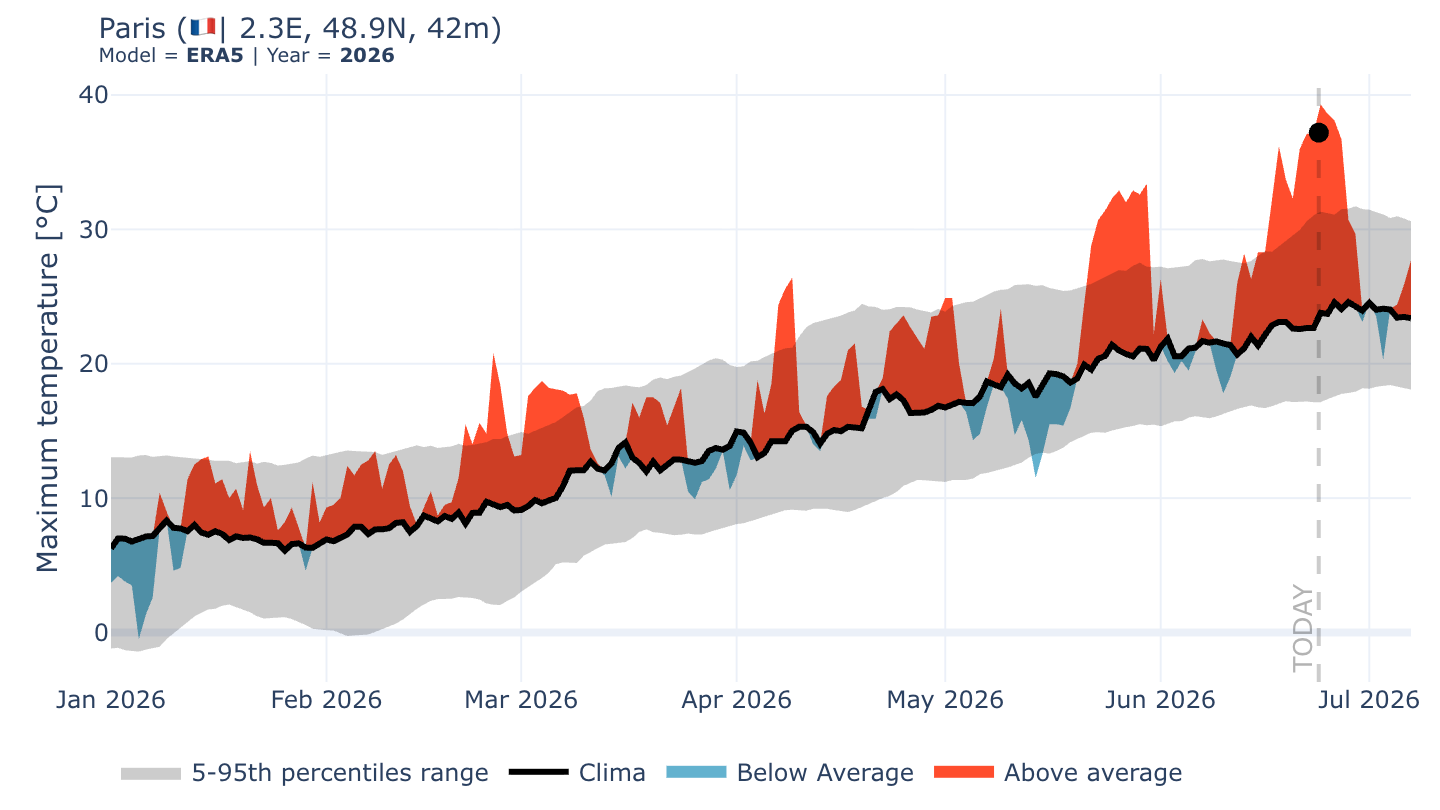
The second idea is something I love so much that I hope someone makes it a reality. Julia Steinberger, a professor of society and climate change in Switzerland, suggested updating weather apps to show pre-climate change averages alongside today's forecast. It would be a constant reminder that 'normal' has changed. Weather apps already show humidity, UV index and air pressure. Why not historical context, too?
JUST A GREAT TREE
Following last week's dispatch on the value of trees, I ventured into the Scottish Highlands to find some of my own. This is the Birnam Oak, which is apparently over 600 years old.
Right now, building this newsletter means I don't have the best work-life balance. So, it was wonderful to get out of the city and recharge for a couple of days! If you're enjoying Not-Ship, it would mean a lot if you became a paying subscriber. It's only $9/month ($90/year) and helps me get one step closer to making this work sustainable.
YOUR TURN
Not-Ship isn't supposed to be a one-way broadcast. Hit reply, tag me on LinkedIn or Bluesky, push back, add context.
On Hacker News, there was some good discussion about last week's 3-30-300 piece. But one message, which popped up in my inbox, has really stayed with me:
A week ago this evening, a handful of us in our town were hit by a tornado. No lives were lost, thank God. My house has damage but it will be fixed. BUT 16 trees in my yard were completely uprooted. Most of them, large, mature trees. And, probably another 6-8 trees were topped, and will have to be taken down. I estimate we lost about 80% of our trees. This saddens me so much. Our sanctuary lost. We can replant, but they will not mature in our lifetime. Trees definitely make our lives better. — Monica
Thanks for sharing, Monica 💙.
FROM ELSEWHERE
Here's what I found interesting, important or delightful this week:
"For the past four years, T2 has been my home." Singapore's Changi Airport has become home to a number of rough sleepers. Another incredible piece of journalism from the Straits Times. It's touching and beautifully illustrated.
The world's first trillionaire... LIVE! Oh great. Elon Musk recently became the world's first trillionaire. At least you can watch his net worth increase while you're on an unpaid coffee break.

MORE NOT-SHIP
 Amanda Shendruk
 Amanda Shendruk
 Amanda Shendruk
Member discussion