
This week, Not-Ship is heavy on musings and light on answers. I'd love to hear your own thoughts on this topic. Bluesky. LinkedIn. Email. I always reply.
💙 Amanda
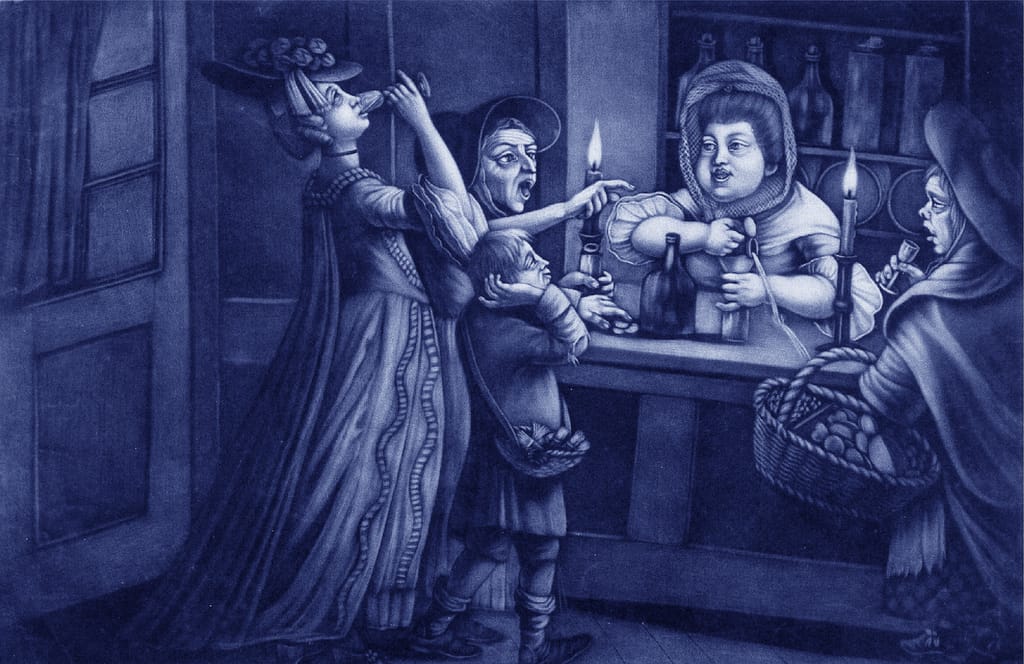
In 1989, urban sociologist Ray Oldenburg argued that Happy Hour is vital to democracy.
"What the tavern offered long before television or newspapers was a source of news along with the opportunity to question, protest, sound out, supplement, and form opinion," he wrote in The Great Good Place. "And these active and individual forms of participation are essential to a government of the people."
For Oldenburg, the pub was the ideal 'third place' — those hangouts outside home and work where regulars gather. Cafes, barber shops, parks, curling rinks, nail salons. Neutral ground where you can relax, the banter is good and everybody knows your name.
These casual gathering spots, he argued, are important to healthy communities and democracies. Research agrees. The habit of regularly gathering — whether to debate current events or just shoot the shit — builds trust, promotes civility, and helps fight loneliness. Studies also show that online communities don't fully replicate the benefits of in-person hangs.
Today, there's a growing sense that these kinds of places are disappearing.
For taverns, the evidence is straightforward. Beer gardens are on the decline in Germany. Bars are disappearing in Canada. Last year, one pub a day shuttered in England and Wales. And pour one out for poor Ireland:
Pubs in Ireland have decreased by 25% since 2005
The number of pub licenses issued each year.
But for other third places, the picture is less clear. The most recent look at US third places (published this past November) shows trends thrown off course by Covid.
Immediately prior to 2020, many third places were multiplying — recreation centres, coffee shops, and restaurants were all on the rise. Some groups were dropping off, such as senior centres and barber shops, but most weren't. Then came the Covid slump.
Just before the pandemic, many third places were increasing in number
Number of sites for every 100,000 people in the United States.
The data end before Covid ran its course. Without more recent numbers, we don't know if these places rebounded or continued their decline. And unfortunately, I wasn't able to find comparable data for Canada or the UK.
If the data are inconclusive — if I can't comfortably tell you that third places are definitely disappearing — why does it feel so strongly like they are?
Honestly, I'm not really sure. But here's how I'm thinking about it.
Maybe it's because they are disappearing and we just don't have new enough or nuanced enough data.
Or perhaps these spaces continue to exist, but no longer function the way Oldenburg imagined them. His ideal requires more than a physical location; it requires regulars, ritual, and time.
By that measure, things have certainly changed.
Across the OECD, people are meeting less often in person.
We're spending less face-to-face time with friends
In OECD countries, the percentage point change in respondents who socialize with friends, from 2006 to 2022.
Solo dining has surged in Canada, the UK and the US. Americans are spending more time at home than in previous decades. At Starbucks, the world's largest coffee shop chain, quick stops have overtaken long stays; as of 2024, 70% of sales were in-app or drive-thru orders. We don't linger as long in public spaces.
These aren't necessarily signs of places vanishing from the landscape. It's just us vanishing from the places.
There's another possibility: Maybe we're simply feeling the absence of what third places provide. Trust, acceptance and civility are concerningly low. And social isolation has been rising worldwide for years. Spaces vital to democracy seem more important when democracy seems threatened. And starved for connection and community, we notice more keenly when the spaces meant to foster them aren't there, or aren't working.
BECOME A REGULAR
Not-Ship can't replace your local pub, but it can give you something to talk about while you're there. And for roughly the cost of a pint, show up here every week feeling proud to be a patron.
KEEP IN MIND
Even in 1989, third spaces weren't perfect. Back then, Oldenburg was already worried that car-dependent sprawl and television were eroding American public life. And the golden ages he invoked — the revolutionary taverns of 18th century America, the coffeehouses of Enlightenment England — were only places of well-being for a select few. Today, third places are still not equally accessible by all.
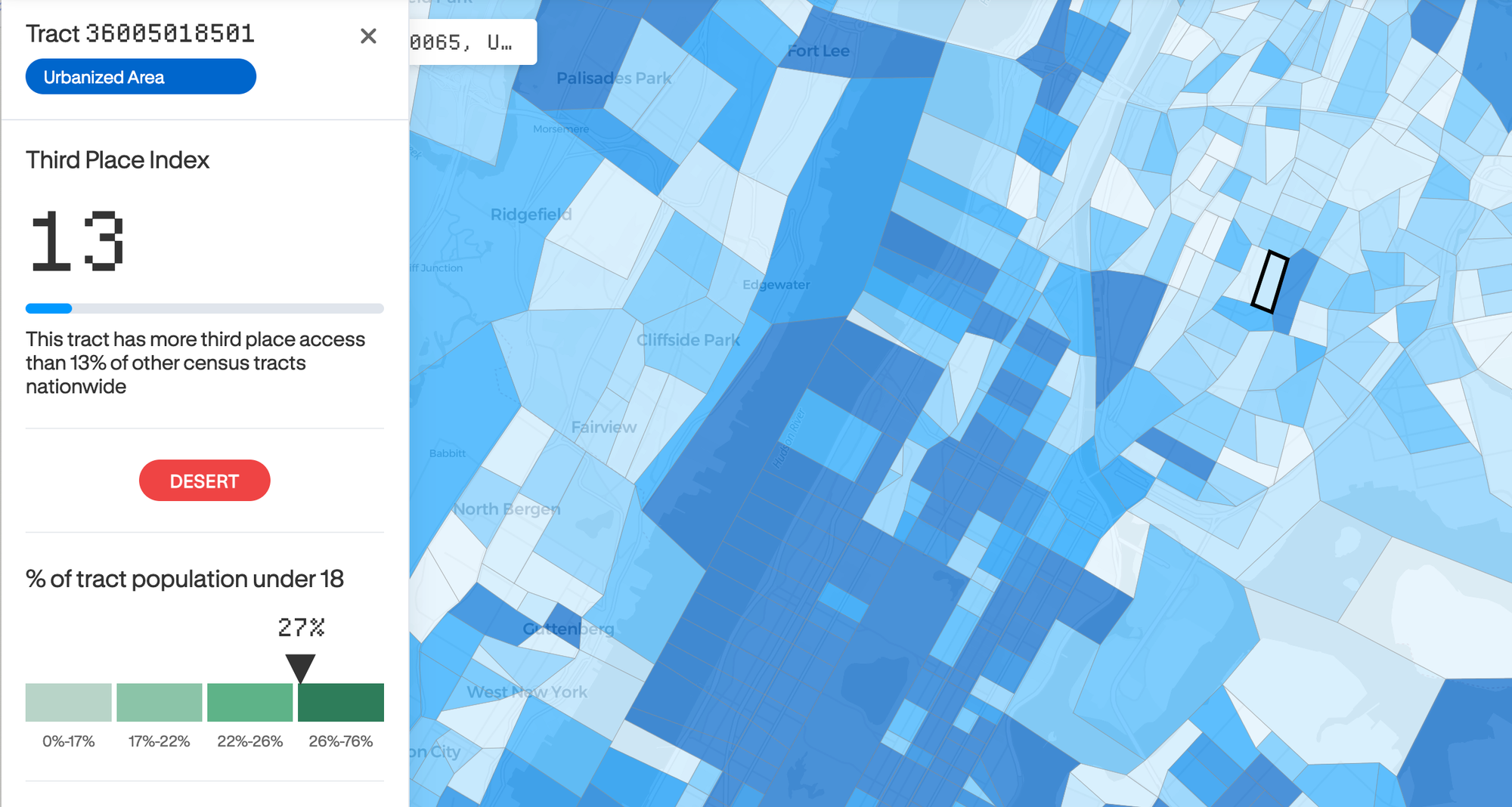
Speaking of which, data communicator Evan O'Neil recently launched an interactive tool measuring access to third places across every US census tract. By his own analysis, areas with the most kids have fewer third places.
FROM ELSEWHERE
Here's what I found interesting, important or delightful this week:
'I never wore a collar until this'. This six-minute story about a pastor in Minnesota is a real gut punch. From the podcast Articles of Interest, it's a thoughtful take on the power of symbols.
One Cthulhu pot, please. I came across these be-tentacled ceramics last week. They're created by UK-based artist Rose Schmits and I've never needed something so badly.

I think I understand private equity now? Your Brain on Money explains why the quality of everything feels worse these days. Along the way, you get a pretty good plain-English explanation of private equity firms
Member discussion