

Not-Ship is six months old today! To celebrate, I'm running a ten-day campaign to find 15 new paying members. If you're a free subscriber, you'll get a few extra emails between now and May 1. I promise they won't be spammy.
💚 Amanda
It used to be so easy for companies to be Environmentally Friendly™️. Use green. Feature some nature (bonus points for a polar bear). Use more green.
Greenwashing — making false or misleading claims about corporate environmental practices — has been in the PR playbook since the 1980s. Many of the strategies are now familiar: Nature imagery, environmental buzzwords, certifications that require no action, unambitious targets, or simply lying.
You know the kind of thing:
But it's the fossil fuel industry — companies that are the worst offenders of the climate crisis, and have the most to lose when we finally get our act together — that is most urgently seeking new greenwashing strategies.
They're getting harder to spot, but researchers have turned text analysis and AI on the language of company reports themselves, and the patterns they've found are telling.
Futurewashing: All target, no action
Futurewashing is greenwashing that lives in the future tense. It comes in the form of forward-looking statements about plans, goals, ambitions and targets — often unsubstantiated and always unverifiable. Futurewashing can't be fact checked, because it hasn't happened yet. It's just promises.
When Robin Rauner, a researcher at University College Dublin, looked at the most recent annual sustainability reports of 97 fossil fuel companies, she found that 54% of all sentences were about the future. That number varied across individual firms. At 21%, Russia's Rosneft had the lowest share of forward-looking statements. The Australian fuel company Ampol had the highest at 90%.
"Messages containing forward-looking claims can be difficult to scrutinize due to their uncertain nature, lowering the risk of negative impacts to corporate legitimacy while appearing to demonstrate sustainable business practices" writes Rauner.
Perhaps the popularity of future tense is not so surprising for documents that are, by nature, partly aspirational. But when Rauner compared these numbers to the quality of each company's climate targets, the mismatch was striking.
Fossil fuel companies with poor climate targets have a lot to say about the future
Share of forward-looking sentences in sustainability reports compared with the quality of climate targets.
Many of the companies producing the most future-oriented language had the weakest targets to back it up. Around 45% of companies in the study had no aim to achieve net zero by 2050. And among those that did, most excluded Scope 3 emissions. That's the pollution produced when customers actually burn the fuel these companies sell — so, pretty important.
Doublespeak: Renewable lip service
The name comes from George Orwell's 1984, in which 'doublethink' describes the ability to hold two contradictory beliefs simultaneously. For fossil fuel companies, doublespeak is similar: Say one thing, do another. Commit to emissions reductions while lobbying against the policies that would enforce them. Cheer for renewables while pouring 97% of investment into oil and gas.
Researchers at Northeastern and Columbia University analyzed 28 annual reports from four of the world's biggest multinational fossil fuel companies — Shell, BP, TotalEnergies, and ExxonMobil — between 2016 and 2022. Over that period, all but ExxonMobil steadily increased their mentions of renewable energy. But the actually surprising part? Those messages were overwhelmingly positive.
Fossil fuel companies praise renewables
The number of positive, neutral and negative mentions of renewable energies in annual reports, 2016 to 2022.
But in reality, those disproportionately positive renewable mentions contradict the industry's actions. By 2025, just 3% of total sector fuel investment was going to low-emissions sources. The other 97% was still going to fossil fuels.
"The fossil fuel industry's public support for the renewable energy transition is a strategic addition to the industry's extensively coordinated efforts to initially deny climate change, and now acknowledge climate crisis and work to obstruct climate policy through lobbying, advertising, and other forms of communication," explains the report. "[There's] a fundamental discrepancy between their climate goals and their climate actions."
The futurewashing and doublespeak studies were both published this year; they're as current as possible. But the strategies will keep shifting. As long as the gap between climate ambition and climate action remains profitable, there will be another type of 'washing' tomorrow.
To be honest, I'm always surprised greenwashing works for fossil fuel companies at all. It's a bit like believing a viper that tells you its bite isn't poisonous.
But realistically, greenwashing has massive benefits to the industry. By highlighting sustainability efforts — however modest (or true) — fossil fuel companies buy time: Keeping profits flowing while holding stricter regulations at bay. It's not just PR. It's a survival strategy.
NINE DAYS LEFT
Most of you read this dispatch for free. That's by design — I believe data should be accessible to everyone. But it costs real time and money to make. If it's worth something to you, a membership ($9/month) is how you say so.
I'm looking for 15 new paying subscribers by May 1. Thanks to yesterday's new members — hello Jean and Bronwen! — we're off to a good start.
FROM ELSEWHERE
Here's what I found interesting, important or delightful this week:
Blossoming data. A professor spent his career tracking the dates of Japan's cherry blossoms. When he died, there were fears that no one would continue his 1,200-year record.
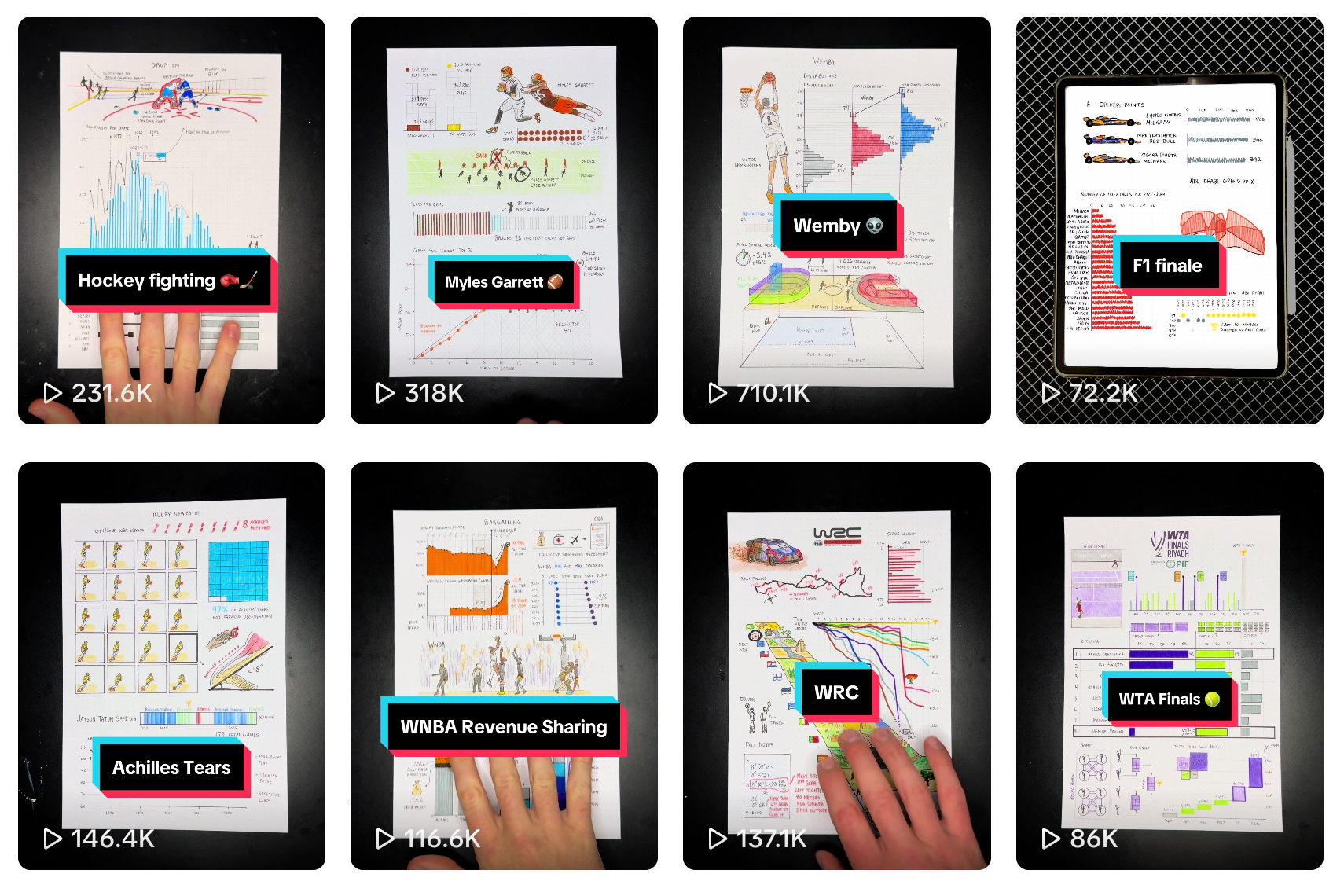
A reason to be on the apps. Don't delay. Go check out the SportsBall account on TikTok or Instagram, where you'll find charming hand-drawn graphs to "help people enjoy sports."
Really super duper hot day. As global temperatures increase, our language needs to keep up. After it experienced its hottest summer on record last year, Japan has introduced a new name for days that reach 40C or above.
MORE NOT-SHIP
 Amanda Shendruk
 Amanda Shendruk
 Amanda Shendruk
Member discussion